
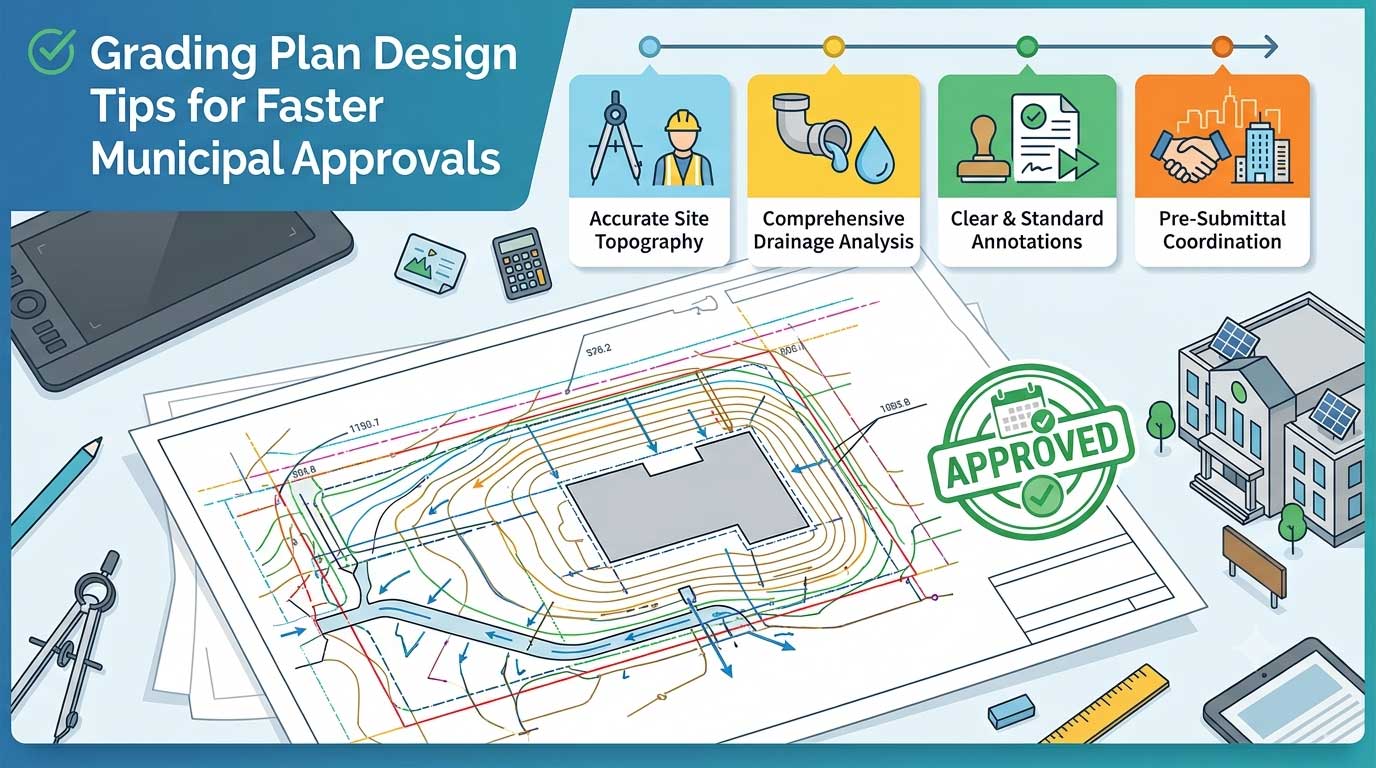
When it comes to land development and site engineering, grading plans play a critical role in the municipal approval process. Whether you are developing a residential subdivision, commercial property, industrial site, or custom home, municipalities carefully review grading plans to ensure proper drainage, site safety, and compatibility with surrounding infrastructure.
A poorly prepared grading plan can result in multiple review comments, project delays, redesign costs, and extended approval timelines. On the other hand, a clear and technically sound grading design helps municipalities review submissions more efficiently and increases the likelihood of faster approvals.
In this article, we will explore the importance of grading plans, common municipal concerns, and practical grading design tips that can help consultants, developers, and property owners streamline the approval process.
What Is a Grading Plan?
A grading plan is a technical drawing that illustrates the proposed elevations, slopes, drainage patterns, and surface grading of a property after development. It demonstrates how stormwater runoff will flow across the site while ensuring that drainage does not negatively impact buildings, neighboring properties, roads, or municipal infrastructure.
Grading plans are typically required for:
Residential developments
Commercial projects
Industrial sites
Parking lots
Custom homes
Site alterations
Municipal infrastructure projects
The plan usually includes:
Existing and proposed elevations
Spot grades
Swales and drainage routes
Retaining walls
Driveway slopes
Catch basins and drainage structures
Property lines
Building footprints
Overland flow routes
Municipal reviewers use grading plans to verify that the proposed development complies with local engineering standards, stormwater management requirements, and safety regulations.
Why Municipalities Carefully Review Grading Plans
Improper grading can create serious problems for both the property owner and the municipality. Poor drainage design may lead to:
- Flooding near buildings
- Water ponding in parking areas
- Soil erosion
- Ice accumulation during winter
- Basement water infiltration
- Drainage disputes between neighboring properties
- Damage to municipal roads and infrastructure
Because of these risks, municipalities often perform detailed reviews of grading submissions before issuing approvals or permits.
A grading plan that clearly demonstrates proper drainage and compliance with municipal requirements reduces reviewer concerns and speeds up the approval process.
Key Principles of an Effective Grading Plan
1. Provide Positive Drainage Away from Buildings
One of the most important principles in grading design is ensuring positive drainage away from all structures.
Water should never accumulate near building foundations. Poor drainage around structures can cause:
- Basement flooding
- Foundation settlement
- Structural damage
- Mold and moisture issues
Most municipalities require a minimum slope away from buildings, typically ranging from 2% to 5% within the first few meters from the foundation.
Design Tips
- Ensure finished grades slope away from the building perimeter.
- Avoid flat areas near foundations.
- Use swales where necessary to redirect runoff.
- Verify that downspouts discharge properly.
- Coordinate grading with landscaping design.
Proper building drainage is one of the first items municipal reviewers examine during grading reviews.
2. Maintain Compatibility with Adjacent Properties
Municipalities pay close attention to how a proposed grading design affects neighboring lands.
A grading plan should not create drainage problems for adjacent properties by directing additional runoff onto neighboring lots. Elevation differences between properties must be carefully managed to avoid conflicts.
Common Issues
- Excessive retaining wall heights
- Steep slopes along property lines
- Redirected stormwater toward adjacent lots
- Drainage concentration at lot boundaries
Design Tips
- Match existing grades where feasible.
- Use gradual transitions between elevations.
- Minimize abrupt grade changes.
- Provide swales or catch basins to control runoff.
- Coordinate grading with neighboring developments.
A design that respects surrounding properties is more likely to receive faster municipal acceptance.
3. Establish Proper Overland Flow Routes
During heavy rainfall events, storm sewer systems can become overwhelmed. Municipalities therefore require safe overland flow routes to direct excess water away from buildings and critical infrastructure.
Overland flow routes act as emergency drainage pathways during major storms.
Important Considerations
- Water should flow toward safe discharge points.
- Flow routes should avoid structures and entrances.
- Ponding depths should remain within acceptable limits.
- Emergency drainage should be clearly illustrated on the plan.
Design Tips
- Use swales and low points strategically.
- Maintain continuous drainage paths.
- Avoid trapping runoff in enclosed areas.
- Verify that major system flow routes function properly.
Municipal reviewers often reject grading plans that do not clearly demonstrate safe overland drainage.
Additional Tips for Faster Municipal Approvals
4. Follow Municipal Design Standards
Each municipality has its own engineering guidelines and grading criteria. Failing to follow local standards is one of the most common causes of review comments.
Before starting the design, review:
- Municipal engineering standards
- Site alteration bylaws
- Stormwater guidelines
- Lot grading criteria
- Accessibility requirements
Common Municipal Requirements
- Minimum and maximum slope percentages
- Driveway slope limitations
- Swale depth standards
- Retaining wall regulations
- Stormwater storage requirements
Understanding local requirements early in the project can prevent significant redesign later.
5. Use Clear and Readable Drawings
Even technically correct grading plans can receive delays if the drawings are cluttered or difficult to interpret.
Municipal reviewers appreciate plans that are organized, legible, and professionally presented.
Best Practices
- Clearly label spot elevations.
- Use consistent line types and symbols.
- Include north arrows and scale bars.
- Differentiate existing and proposed grades.
- Highlight drainage flow directions.
- Avoid excessive overlapping information.
A clean drawing reduces confusion and allows reviewers to assess the design more efficiently.
6. Coordinate Grading with Stormwater Management Design
Grading and stormwater management are closely connected. Municipal reviewers expect both systems to work together seamlessly.
Improper coordination between grading and stormwater systems can create conflicts such as:
- Inadequate drainage slopes
- Ponding near structures
- Inefficient catch basin placement
- Overflow issues
Design Tips
- Coordinate catch basin elevations with grading.
- Ensure drainage patterns align with stormwater infrastructure.
- Verify stormwater outlet elevations.
- Consider future maintenance access.
Integrated design improves both functionality and approval efficiency.
7. Minimize the Need for Retaining Walls
Retaining walls can increase project costs and complicate approvals, especially when located near property lines.
While retaining walls are sometimes unavoidable, municipalities generally prefer grading solutions that minimize their use.
Challenges with Retaining Walls
- Structural design requirements
- Safety concerns
- Maintenance responsibilities
- Neighboring property impacts
Alternatives
- Use gradual slopes where space permits.
- Adjust site layout to reduce elevation differences.
- Reconfigure parking or building locations.
Reducing retaining wall dependency can simplify municipal review.
8. Consider Accessibility Requirements
Modern developments must comply with accessibility standards, especially for commercial and public projects.
Grading design directly affects accessible pathways, parking spaces, and entrances.
Key Accessibility Factors
- Maximum walkway slopes
- Cross slope limitations
- Barrier-free access routes
- Accessible parking grades
Failure to coordinate grading with accessibility standards may result in additional review comments and revisions.
9. Address Construction Feasibility
Municipal reviewers also consider whether the proposed grading can realistically be constructed in the field.
Overly complex grading designs may create problems during construction.
Practical Design Tips
- Avoid unnecessary grade breaks.
- Maintain achievable slopes.
- Ensure equipment access during construction.
- Coordinate with utility layouts.
Simple and practical grading solutions often perform better both during review and construction.
10. Conduct Thorough Quality Control Before Submission
Many approval delays occur because of avoidable drafting or coordination errors.
Before submitting the grading plan:
- Verify all elevations.
- Check drainage flow directions.
- Confirm slope calculations.
- Review spot grade consistency.
- Coordinate with architectural and servicing drawings.
- Ensure all notes and legends are complete.
Internal quality control can significantly reduce municipal comments and resubmission cycles.
Common Reasons Grading Plans Get Rejected
Understanding common municipal concerns can help avoid unnecessary delays.
Frequent Issues Include:
- Negative drainage near buildings
- Missing overland flow routes
- Drainage directed onto neighboring properties
- Non-compliant slopes
- Incomplete spot elevations
- Conflicts with stormwater systems
- Poor drawing clarity
- Insufficient grading information
Avoiding these mistakes improves the likelihood of first-round approval.
The Importance of Early Coordination
Successful grading design requires collaboration between multiple disciplines, including:
- Civil engineers
- Architects
- Surveyors
- Landscape architects
- Municipal reviewers
- Developers
Early coordination helps identify conflicts before submission and reduces redesign during the review process.
Projects with integrated planning typically move through municipal approvals more efficiently.
Conclusion
Grading plans are one of the most important components of any municipal submission. A properly designed grading plan not only protects buildings and surrounding properties but also demonstrates compliance with municipal engineering requirements.
Key principles such as positive drainage away from buildings, compatibility with adjacent properties, and safe overland flow routes are essential for successful approvals. In addition, clear drawings, coordination with stormwater systems, adherence to municipal standards, and strong quality control can significantly reduce review comments and accelerate project timelines.
By focusing on practical, technically sound, and municipality-friendly grading design, developers and consultants can improve project efficiency, minimize revisions, and achieve faster municipal approvals.