
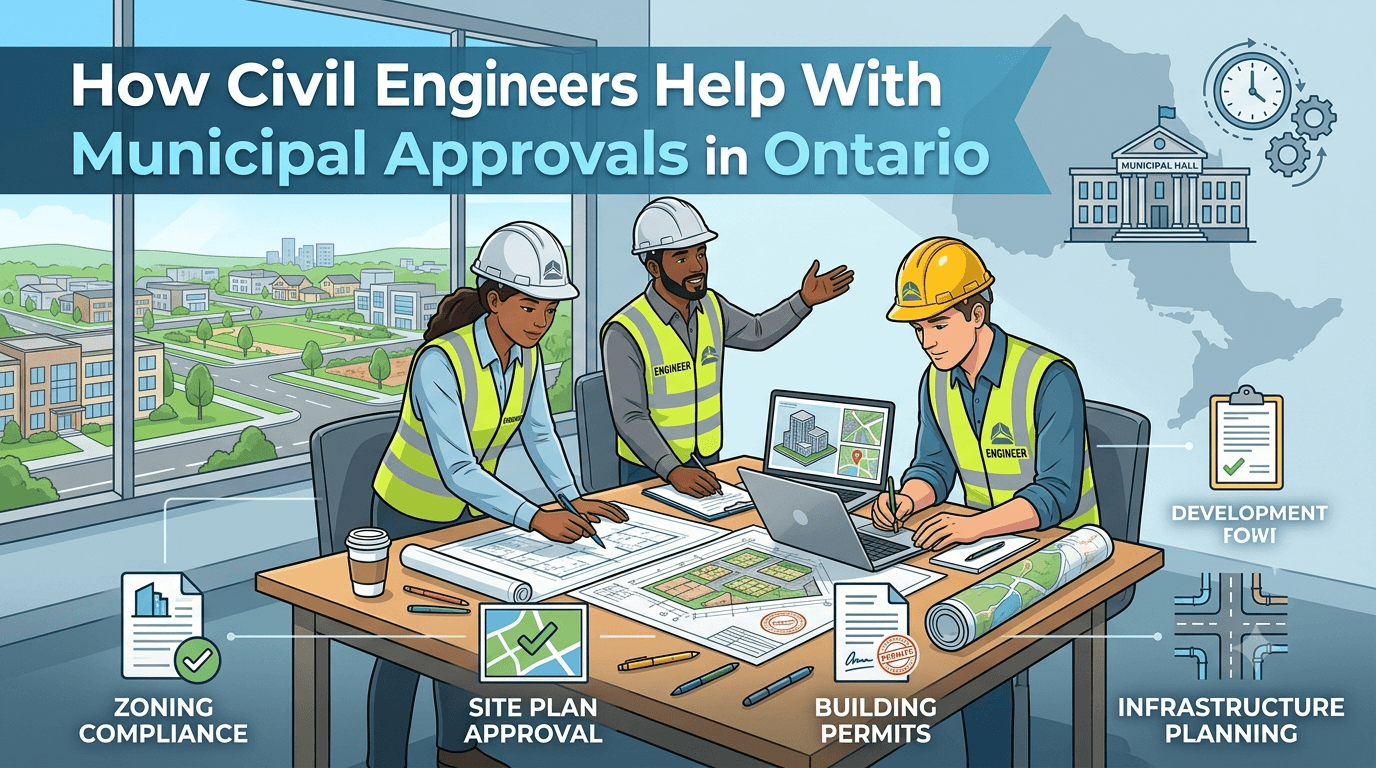
Planning a property development or construction project in Ontario often involves more than architectural drawings and construction plans. Many projects also require engineering documents and municipal approvals before construction can move forward.
This is where a civil engineering consultant in Ontario can make a significant difference. Civil engineers help property owners, developers, contractors, architects, and other professionals address technical requirements related to site servicing, grading, drainage, stormwater management, erosion and sediment control, and municipal infrastructure.
They can also help prepare engineering drawings and reports required for municipal review and respond to technical comments during the approval process. we explain how civil engineers help with municipal approvals in Ontario and why involving an engineer early can make your development project more efficient.
What Are Municipal Approvals?
Municipal approvals are permissions or technical reviews required by a municipality before certain development or construction activities can proceed.
The exact process depends on the type, size, and location of the project.
A development may involve requirements related to:
- Site plan approval
- Building permits
- Development applications
- Site servicing
- Grading and drainage
- Stormwater management
- Road access
- Utility connections
- Erosion and sediment control
- Municipal infrastructure
- Environmental considerations
Different municipalities may have different requirements, standards, application procedures, and review processes. That is why understanding the engineering requirements early can be important.
Why Are Civil Engineers Important for Municipal Approvals?
Municipalities need to make sure proposed developments work safely with existing infrastructure and do not create avoidable problems for surrounding properties or public infrastructure.
Civil engineers provide the technical analysis and design needed to demonstrate how a proposed development will function.
For example, a municipality may need to understand:
- How water will enter and leave the property
- Where stormwater will drain
- How the site will connect to municipal services
- Whether proposed grades work with surrounding properties
- How runoff will be controlled
- How construction activities will be managed
- Whether existing infrastructure can support the development
A civil engineer can prepare the necessary technical drawings, calculations, reports, and supporting documentation.
1. Reviewing Existing Site Conditions
One of the first things a civil engineer does is review the existing conditions of the property.
This can include reviewing:
- Property boundaries
- Existing elevations
- Existing buildings
- Roads
- Driveways
- Drainage patterns
- Municipal services
- Storm systems
- Sanitary systems
- Water services
- Existing infrastructure
- Available survey information
2. Preparing Site Servicing Plans
A site servicing plan can be an important component of a development application.
The plan may show how a proposed development will connect to municipal infrastructure.
Depending on the project, this can include:
- Water servicing
- Sanitary servicing
- Storm servicing
- Service connections
- Utility corridors
- Catch basins
- Storm sewers
- Sanitary sewers
- Watermain connections
The civil engineer designs the proposed servicing arrangement and prepares drawings that communicate the technical details to the municipality. Municipal reviewers can then evaluate whether the proposed servicing approach is appropriate.
3. Designing Grading and Drainage
Grading is one of the most important engineering considerations in land development. A grading plan shows proposed elevations across the site and helps establish how surface water will move.
Civil engineers consider:
- Existing elevations
- Proposed elevations
- Building elevations
- Driveway slopes
- Sidewalks
- Parking areas
- Property boundaries
- Road elevations
- Drainage patterns
- Adjacent properties
A properly prepared grading and drainage plan helps municipalities understand how the proposed site will function.
4. Developing Stormwater Management Solutions
Stormwater management is another important part of many development applications in Ontario. When a property is developed, natural surfaces may be replaced by:
- Buildings
- Driveways
- Roads
- Parking areas
- Sidewalks
- Patios
These surfaces can increase runoff compared with existing conditions. Civil engineers evaluate the site’s stormwater characteristics and develop appropriate management solutions.
A stormwater management plan or report may be required depending on the municipality and project. The engineer can prepare the required calculations, drawings, and supporting documentation for municipal review.
5. Preparing Functional Servicing Reports
Some development applications require a Functional Servicing Report (FSR). An FSR helps demonstrate how a proposed development can be serviced by available infrastructure. A functional servicing assessment may address:
Water
The engineer evaluates the proposed water demand and connection to the existing system.
Sanitary
The engineer evaluates sanitary flows and the proposed connection.
Stormwater
The engineer considers runoff, drainage, and stormwater management requirements.
Infrastructure Capacity
The project may need to consider whether existing municipal infrastructure can accommodate the proposed development. The exact scope of a Functional Servicing Report depends on the municipality and project.
6. Preparing Erosion and Sediment Control Plans
Construction activities can disturb soil and create sediment runoff. If sediment enters municipal storm systems, roads, or nearby watercourses, it can create environmental and infrastructure concerns. Civil engineers can develop erosion and sediment control plans to help manage these risks during construction.
Possible measures include:
- Sediment barriers
- Construction entrances
- Temporary drainage controls
- Sediment traps
- Soil stabilization
- Site protection measures
- Construction-phase stormwater controls
The appropriate measures depend on site conditions and project requirements.
7. Supporting Site Plan Approval
A site plan application may involve multiple professionals.
The project team may include:
- Property owner
- Developer
- Architect
- Civil engineer
- Surveyor
- Planner
- Landscape architect
- Other consultants
The civil engineer focuses on the site’s technical infrastructure. Good coordination between consultants can help prevent conflicts between different drawings.
8. Responding to Municipal Engineering Comments
Submitting engineering drawings is not always the end of the process. Municipal staff may review the documents and provide comments or request revisions.
The civil engineer can review these comments, make necessary revisions, and prepare responses. This process may continue through multiple review cycles depending on the complexity of the project. Having an engineer involved throughout the review process can make it easier to address technical comments accurately.
9. Coordinating With Municipal Staff
Civil engineers may communicate directly with municipal engineering departments and other project stakeholders.
This communication can help clarify:
- Engineering requirements
- Submission requirements
- Technical comments
- Design concerns
- Servicing requirements
- Stormwater requirements
- Grading issues
Clear communication is particularly important when a project involves multiple technical disciplines.
10. Helping Identify Problems Before Submission
One of the biggest advantages of hiring a civil engineer early is the ability to identify potential problems before submitting an application.
For example, an engineer may identify:
- Insufficient drainage capacity
- Difficult site grading
- Conflicts with existing infrastructure
- Limited servicing options
- Stormwater constraints
- Driveway grading issues
- Potential impacts on neighbouring properties
Finding these problems early gives the project team an opportunity to modify the design before submitting the application. That can potentially reduce unnecessary revisions later.
11. Helping With Development in Mississauga and the GTA
Municipal requirements can vary across Ontario. For projects in the Greater Toronto Area, understanding local processes can be particularly valuable. Property owners and developers may need engineering support for projects in municipalities such as:
- Mississauga
- Brampton
- Oakville
- Milton
- Toronto
- Vaughan
- Other GTA municipalities
A civil engineering consultant familiar with the local area can help the project team understand the engineering components that may be required.
However, requirements depend on the specific project and municipality, so the appropriate engineering scope should always be confirmed for the individual application.
How P Engineering Solutions Can Help
P Engineering Solutions provides civil engineering services for property owners, developers, and project teams in Ontario and the Greater Toronto Area.
Our services include:
- Site Servicing
- Grading & Drainage
- Functional Servicing Reports
- Stormwater Management
- Erosion & Sediment Control
- Civil Engineering Support
We can help project teams address engineering requirements from initial site review through design, municipal submission, and responses to engineering comments.
Whether you are planning a residential development, commercial project, redevelopment, or another type of property improvement, early civil engineering consultation can help you understand the technical requirements of your project.
Planning a development project in Ontario? Contact P Engineering Solutions to discuss your civil engineering requirements and determine how we can support your project.
Frequently Asked Questions
What does a civil engineer do for municipal approval?
A civil engineer prepares technical drawings, reports, calculations, and engineering designs required for municipal review. They may also respond to municipal engineering comments and coordinate revisions.
Is civil engineering required for site plan approval in Ontario?
Many projects require civil engineering documentation as part of the site plan or development approval process. The exact requirements depend on the municipality and project.
What civil engineering documents may be required?
Depending on the project, requirements may include site servicing plans, grading and drainage plans, stormwater management reports, functional servicing reports, and erosion and sediment control plans.
How long does municipal approval take in Ontario?
The timeline varies depending on the municipality, application type, project complexity, completeness of the submission, and review comments. Applicants should confirm current timelines and requirements with the applicable municipality.
Can a civil engineer respond to municipal comments?
Yes. Civil engineers can review technical comments from municipal staff, revise engineering documents, provide technical responses, and resubmit the required information.
Why is stormwater management important for municipal approval?
Stormwater management helps demonstrate how a proposed development will control runoff and address potential impacts on municipal drainage systems and surrounding properties.
Should I hire a civil engineer before an architect?
There is no single rule for every project. However, involving a civil engineer early can help identify grading, drainage, servicing, and stormwater constraints that may affect the overall site design.
Conclusion
Municipal approvals can involve many technical requirements, and civil engineering is an important part of the process for many Ontario development projects.
From site servicing and grading to stormwater management, functional servicing, erosion control, and municipal engineering submissions, a civil engineer can help transform a proposed development into a technically coordinated plan.
The earlier you identify engineering requirements, the easier it can be to address potential problems before they become costly design changes.
If you are planning a development project in Mississauga, Brampton, Oakville, Milton, Toronto, or elsewhere in Ontario, consider consulting a civil engineering professional early in the planning process.
your next civil engineering project.