
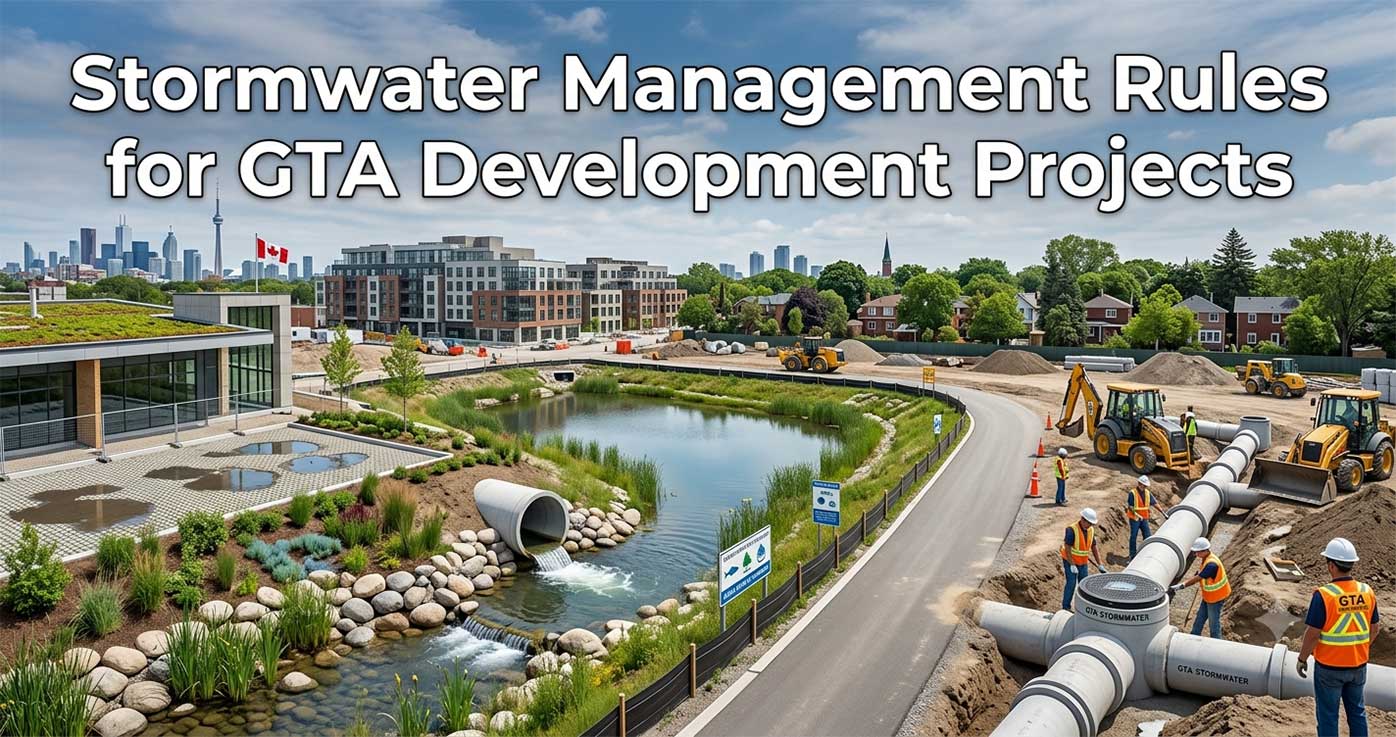
Stormwater requirements are rules established by municipalities to control rainwater runoff from developments and construction sites.
When natural land is replaced with roads, parking lots, buildings, and sidewalks, rainwater can no longer soak into the ground naturally. Runoff volumes increase, which can cause flooding, erosion, infrastructure damage, and water pollution.
Most municipalities require developers to prepare engineering studies that demonstrate how stormwater will be managed before approval is granted.
Common requirements include:
- Stormwater Management Reports
- Grading Plans
- Drainage Plans
- Erosion and Sediment Control Plans
- Low Impact Development measures
- Construction monitoring
Although Mississauga, Brampton, and Toronto share similar goals, each city applies different design standards, review procedures, and documentation requirements.
Understanding these differences early can reduce delays during municipal review and approval.
Developers who account for stormwater requirements during project planning often experience faster approvals and lower construction risks.
Effective stormwater management also helps municipalities meet provincial environmental goals while protecting local watersheds, streams, and communities.
Why Stormwater Compliance Matters for Development Projects
Stormwater compliance affects every stage of a development project.
From initial design through construction and final occupancy, municipalities require proof that runoff will be controlled safely.
Failure to meet requirements can result in:
- Permit delays
- Costly redesigns
- Stop-work orders
- Regulatory penalties
- Additional inspections
Stormwater Requirements in Mississauga
Mississauga follows comprehensive stormwater management policies designed to protect local watersheds and support sustainable growth.
Developers are typically required to submit stormwater studies for new developments, site plan applications, and redevelopment projects.
Municipal reviewers assess:
- Runoff quantity
- Water quality treatment
- Erosion control
- Flood protection
- Groundwater impacts
Mississauga places strong emphasis on watershed-based planning.
Developments must demonstrate consistency with municipal and conservation authority requirements.
Stormwater systems are evaluated based on their ability to control peak flow rates and maintain downstream drainage conditions.
The city increasingly encourages Low Impact Development practices.
These approaches reduce runoff close to its source and improve infiltration.
Projects may also require ongoing maintenance plans to ensure long-term system performance.
Early consultation with municipal staff often helps identify project-specific requirements and reduces approval timelines.
Key Design Standards in Mississauga
Mississauga requires engineering designs that address both water quantity and water quality objectives.
Designs must typically account for various storm events and demonstrate adequate system capacity.
Common design considerations include:
- Detention storage
- Peak flow control
- Water balance targets
- Erosion mitigation
- Pollution removal
The city encourages green infrastructure wherever feasible.
Examples include rain gardens, infiltration systems, and permeable pavement installations.
Developers must ensure proposed systems can be maintained throughout their operational life.
Design submissions are reviewed for compliance with municipal standards and watershed objectives.
Approval Process and Documentation
Stormwater approval in Mississauga generally requires detailed technical documentation.
Typical submissions include:
- Stormwater Management Report
- Functional Servicing Report
- Grading Plan
- ESC Plan
- Drainage Analysis
Municipal staff review submissions and may request revisions.
Construction inspections are often required to verify installation quality and compliance.
Final approvals depend on successful implementation of approved stormwater measures.
Stormwater Requirements in Brampton
Brampton has developed extensive stormwater policies to support rapid urban growth while protecting environmental resources.
Stormwater management is integrated into land development review processes.
The city evaluates how developments affect:
- Drainage patterns
- Water quality
- Flood risk
- Erosion potential
Applicants are expected to demonstrate that proposed systems meet municipal engineering requirements.
Brampton supports sustainable stormwater solutions that reduce runoff and improve environmental outcomes.
Developers frequently coordinate with conservation authorities and municipal reviewers during project approvals.
The city also focuses on long-term infrastructure resilience.
Stormwater facilities must be designed to function effectively under changing rainfall conditions and future growth scenarios.
Projects that address these factors early generally move through approvals more efficiently.
Brampton Stormwater Design Criteria
Brampton requires detailed hydraulic and hydrologic analysis.
Design criteria often include:
- Runoff control targets
- Storage requirements
- Water quality treatment
- Erosion prevention measures
Developers may need to evaluate multiple storm scenarios.
Designs should minimize downstream impacts and support watershed objectives.
Low Impact Development practices are increasingly encouraged to complement traditional infrastructure.
These systems help reduce runoff volume while improving groundwater recharge.
Required Reports and Inspections
Brampton generally requires comprehensive engineering documentation.
Common reports include:
- Stormwater Management Report
- Functional Design Studies
- ESC Plans
- Servicing Reports
Municipal reviewers assess technical accuracy and compliance.
Construction inspections verify that approved measures are installed correctly.
Additional monitoring may be required depending on project scope and location.
Stormwater Requirements in Toronto
Toronto applies some of the most advanced stormwater management standards in Ontario.
The city’s approach combines flood protection, water quality improvement, and sustainable urban development.
Toronto places significant emphasis on green infrastructure and Low Impact Development.
Stormwater reviews often focus on reducing runoff at its source.
Developers may be required to incorporate:
- Green roofs
- Bioretention systems
- Permeable surfaces
- Underground storage facilities
The city also prioritizes climate resilience.
Stormwater systems must be capable of handling increasingly intense rainfall events.
Projects are evaluated based on both engineering performance and environmental benefits.
Toronto’s standards often exceed minimum requirements found in other municipalities.
Toronto Green Infrastructure and LID Standards
Toronto actively promotes Low Impact Development technologies.
These systems replicate natural hydrologic processes.
Popular solutions include:
- Rain gardens
- Bioswales
- Green roofs
- Infiltration galleries
The city encourages designs that reduce storm sewer demand.
Developments may need to achieve specific runoff reduction targets.
Green infrastructure also supports urban cooling, biodiversity, and improved water quality.
Stormwater Review and Approval Process
Toronto’s review process is highly detailed.
Applicants commonly submit:
- Stormwater Management Reports
- Servicing Reports
- Grading Plans
- Hydraulic Analyses
- ESC Plans
Municipal staff conduct technical reviews and may request revisions.
Projects must demonstrate compliance with applicable municipal standards before approvals are granted.
Construction inspections and post-construction verification may also be required.
Conclusion
Stormwater management plays a critical role in development approvals across Mississauga, Brampton, and Toronto.
Each municipality aims to protect communities, infrastructure, and natural resources through effective runoff management.
While the core objectives remain consistent, differences exist in design expectations, documentation requirements, and approval procedures.
Toronto generally applies the strongest green infrastructure standards.
Mississauga emphasizes watershed-based planning.
Brampton focuses on balancing environmental protection with rapid urban growth.
Developers who understand these distinctions early can reduce delays, improve compliance, and create more resilient projects.
For the best results, review municipal guidelines, consult qualified engineering professionals, and integrate stormwater planning into every stage of project development.